

Paula Cooper Gallery in New York shows Claes Oldenburg: Six Themes from November 5 to December 19, 2026, at 534 West 21st Street. The exhibition includes works for each of the six subjects, some of them rarely seen, from the artist’s estate and private collections. Colossal reported it on 20 October, and the details are on the gallery’s own page. I want to write about it, because those six objects are the best short lesson I know in how to look at ordinary things.
The name is not new. It borrows from a survey that the Walker Art Center in Minneapolis organised in 1975, which then travelled to other museums in North America. The gallery brings the idea back fifty years later.
The six themes are the Geometric Mouse, the Three-Way Plug, Fagends (cigarette butts), the Clothespin, the Typewriter Eraser and the Standing Mitt with Ball. From the 1970s onward he kept coming back to them. He drew them, built soft canvas prototypes, then made large versions in metal. Same subject, three materials, many years. I find that more interesting than a single famous piece. It shows a man who did not finish with an object just because he had made it once.
The most boring things in the room
Look at the list again. A clothespin. An eraser. A plug. The stub of a cigarette. Nobody has ever stood in front of a plug and felt moved. I suspect that is exactly why he chose them.
Oldenburg was born in Stockholm in 1929, worked in the US, and died in 2022. In 1961 he wrote a text for the catalogue of the group show Environments, Situations, Spaces at Martha Jackson Gallery in New York. It begins “I am for an art”, and it goes on as a long list (the Walker Art Center has the full text). People call it a manifesto. He insisted it was not. I like that. A list of things you love is more honest than a program.
In December 1961 he opened The Store, a storefront on East 2nd Street on the Lower East Side, where he made and sold painted plaster versions of food and clothing. The idea was already there: take what people walk past and put it in front of them again.
Scale and softness
His method was simple, and I think it is smarter than it looks. He changed two things, size and hardness.
“Floor Burger” (1962), a giant hamburger of canvas stuffed with foam, is in the Art Gallery of Ontario in Toronto. “Soft Toilet” (1966), vinyl filled with kapok, is in the Whitney Museum of American Art. A toilet is meant to be hard, white and private. Make it limp and it becomes strange, a little funny, a little sad. This is soft sculpture at its most direct. The object keeps its identity, but you can no longer use it without thinking, and that pause is the whole trick.
He also preferred to re-make things rather than pick them up. So these are not readymades. Nothing was bought and signed. Each piece was built, and building forces you to decide what an object really is, which edge matters, which curve you can drop.
Then he made them huge
With Coosje van Bruggen, whom he married in 1977 and who died in 2009, he turned the same logic outward into public space. “Clothespin” (1976), about 45 feet tall and made of steel, stands at Centre Square, 15th and Market Streets, in Philadelphia. “Spoonbridge and Cherry”, installed in 1988, sits in the Minneapolis Sculpture Garden. “Typewriter Eraser, Scale X” (1999) is in the National Gallery of Art Sculpture Garden in Washington DC.
As pop art sculpture goes, this is where the joke gets serious. A clothespin at that size is closer to a building than to a household item. The object did not become important. It was always important, and nobody had noticed.
What obsolescence does to an object
Here is the part that makes the show interesting now. The Geometric Mouse was based on the profile of a film projector. The typewriter eraser and the film projector have both become obsolete since.
My own view is that this changes how the forms read. A viewer who never used either may see only shape: a disc, a wedge, a brush. They look almost abstract. I do not think Oldenburg planned that, and I would not claim he did. But everyday objects in art have a second life that artists cannot control. First the object is so common that it is invisible. Later it disappears, and the art that kept its outline becomes the record of what it looked like.
We are in a faster version of that cycle. Phones, cables, chargers and buttons age out in a few years. The ordinary thing around us today may be a mystery object soon, and I find that a good reason to look at it carefully while it is still ordinary.
My own small parallel
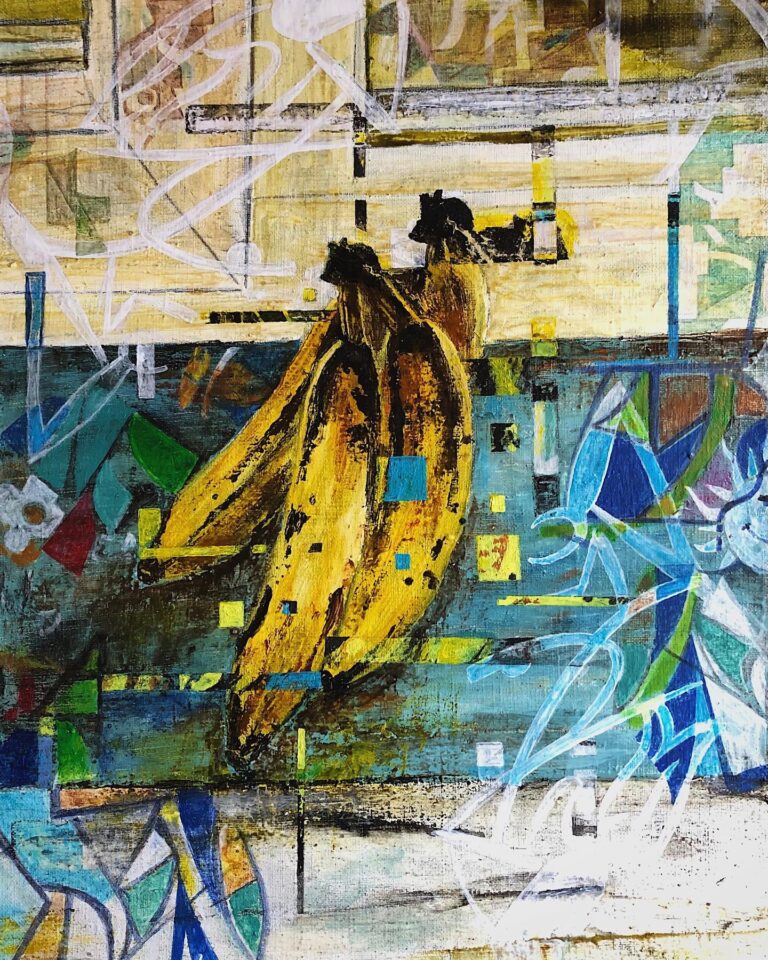
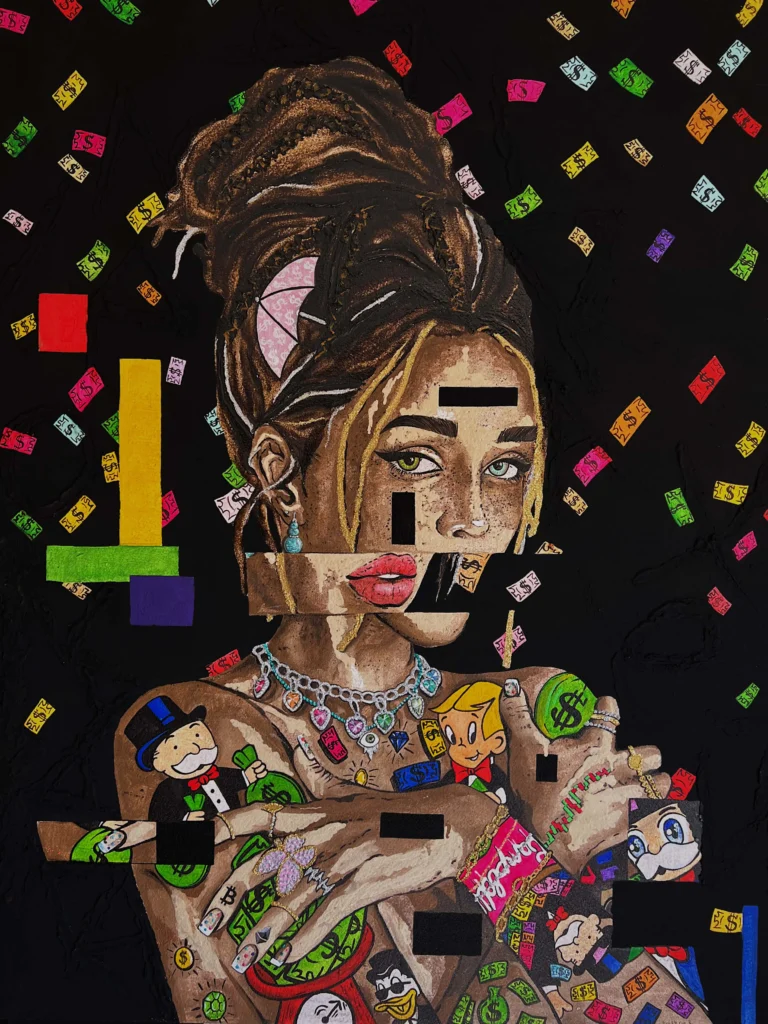
I am a painter, not a sculptor, and I am not copying anyone. Still, I recognise the impulse. My painting Bananas shows a bunch of bruised bananas against cool teal and blue, an ordinary kitchen object that ends up looking like it has something to say. Monopoly Dreams is a woman covered in cartoon money, with Mr. Monopoly, Richie Rich, Scrooge McDuck and falling dollar bills, a board game turned into a portrait. Paintings and hand-finished lithographs, not soft canvas and steel. The parallel is only this: take a familiar thing seriously and see what it does.
If you are in New York before December 19, it is a rare chance to see all six subjects in one place. More notes like this are in the journal.
Anonymous contemporary pop artist with a studio in Poland. I paint original pop art in oil and acrylic and make hand-finished lithographs. About me · More from my journal