

Nobody who paints the Mona Lisa now is really painting a woman in Florence. We paint a reproduction: a postcard, a museum brochure, a silkscreen, a banknote. Over the twentieth century her face turned into something closer to a logo, and I think that is the only reason Mona Lisa pop art could happen. You cannot make pop art from a panel hanging behind glass. You can make it from an image that has been reproduced until everyone owns it.
So each artist below does something different to the reproduction. One defaces it, one signs it with his own face, one multiplies it, one prices it, one smuggles it back into the museum. At the end I say what I did to it.
The Mona Lisa was taken from the Louvre on 21 August 1911. The thief was Vincenzo Peruggia, a man who had worked at the museum. The painting was recovered in Florence in December 1913, after Peruggia contacted the dealer Alfredo Geri, who alerted the police. The Smithsonian account of the theft is one of many that credit it with making this the most famous painting in the world.
I find that useful. A face that well known no longer needs the object underneath it. Once the whole world could picture her without having stood in front of her, she was free to be used.
A postcard with a moustache
The version everyone remembers is Marcel Duchamp’s. In 1919 he took a cheap postcard reproduction, about 19.7 by 12.4 centimetres, and drew a moustache and goatee on it in pencil. Then he added a title, L.H.O.O.Q. Say those letters aloud in French and they turn into a crude joke about her. The piece counts as a rectified readymade: a mass-produced object, adjusted slightly and left to do its work.
He made several versions later. The one I like best is L.H.O.O.Q. Shaved, which is an unmodified reproduction mounted on card. It is the same picture with the joke removed, and somehow it is the sharper gesture. I think his target was the habit of looking at a reproduction and calling that looking at art.
In 1954 Philippe Halsman and Salvador Dalí made a photomontage with Dalí’s face, moustache included, on the Mona Lisa, and money in his hands. It belongs to their book Dali’s Mustache. Money turns up early in this story, and it does not leave.
Thirty Are Better Than One
To see why Andy Warhol Mona Lisa pictures exist, you have to go back to the winter of 1962. Jacqueline Kennedy persuaded France’s culture minister to lend the painting to the United States. It arrived in December 1962, and President Kennedy welcomed it at the National Gallery of Art in Washington on 8 January 1963. The gallery counted 518,525 visitors by 3 February. The painting then went to the Metropolitan Museum of Art in New York, where it hung from 7 February to 4 March. News reports estimated that more than 1.5 million people saw it in total.
Within months of the Met show, Warhol made his first Mona Lisa. He worked from the Met’s exhibition brochure, which carried three photographs: the full portrait, a cropped head and a close-up of the hands. Henry Geldzahler, a friend of his who worked at the Met, may have given him the idea. The most ambitious result is Thirty Are Better Than One, from 1963, a five-by-six grid of black-and-white silkscreened Mona Lisas.
I read that title as a small joke about value. One Mona Lisa is already a famous object, and thirty of them in a grid makes her look like a product on a shelf. Warhol also gave Geldzahler a Mona Lisa from 1963, acrylic and silkscreen on canvas. Geldzahler gave it to the Met in 1965, and it is still there, in the museum’s collection. Warhol came back to the image in the late 1970s, which tells me it was not a one-week idea.
The dollar bill
In 1983 Jean-Michel Basquiat painted his own Mona Lisa, in acrylic and oil stick on canvas. According to the Getty’s record, it is his answer to Warhol’s Dollar Bill and Mona Lisa paintings. Leonardo’s sitter sits over a dollar bill and covers George Washington’s face. The Getty note reads the picture as art and money being two different currencies.
I like that reading because it does not choose a side. Neither currency wins. The sitter simply sits on top of one and hides a president with it.
Back into the Louvre
The Banksy Mona Lisa I mean here is Mona Lisa Smile, from 2004. He put his own version in the Louvre, with a yellow acid smiley where her face should be. Think about the direction of travel. Everyone before him altered the reproduction somewhere outside the museum and let it circulate. He took an altered version and sent it back into the building where the original lives. The loop closes there.
My own version
My version is The Mona Lisa (1), from the collection Modern Realities. I painted the original in 2021. It is sold, but any work can be painted to order, in any size, and the original’s page is still there. Leonardo’s figure sits on black. A sliding glitch strip with a black bar cuts across her mouth, another cuts her hands, and a black square sits on her forehead. Pixel squares float off to the left. Her neck and collar are a hundred-dollar bill, with the Federal Reserve seal and the legal tender line on it. Thick orange and yellow paint runs down her sleeves, and small symbols are drawn on her hand, a dollar sign among them.
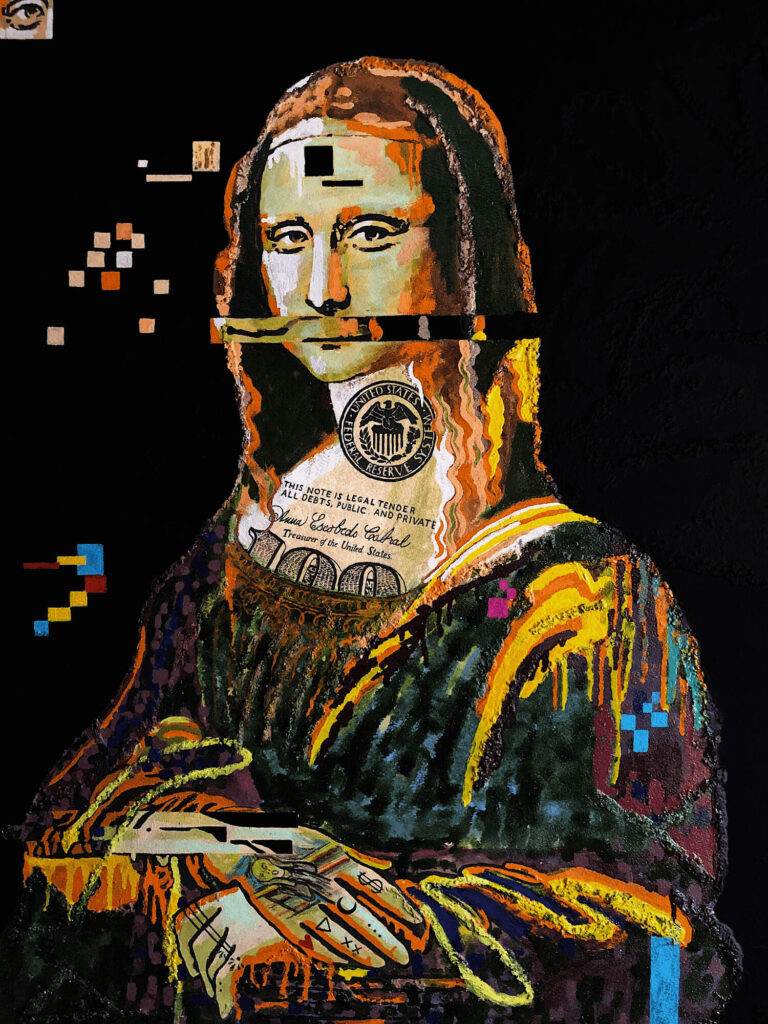
What was I doing? As far as I can tell, I was putting the most reproduced face in art next to money and screens. Warhol had brochures. I have screens, and a screen is where most people meet her now. The glitch strips are the same idea as the moustache: something done to the reproduction, in public, to show that it was only ever a reproduction. If you want the longer argument, I wrote about what glitches mean in painting, and about why artists keep painting money.
Basquiat’s dollar bill and mine land in the same area. I note that as an observation and nothing more. The lithograph of this work, made in 2023, is hand-finished with my acrylic brushstrokes over the print and a textured gel that dries completely clear.
Room for one more
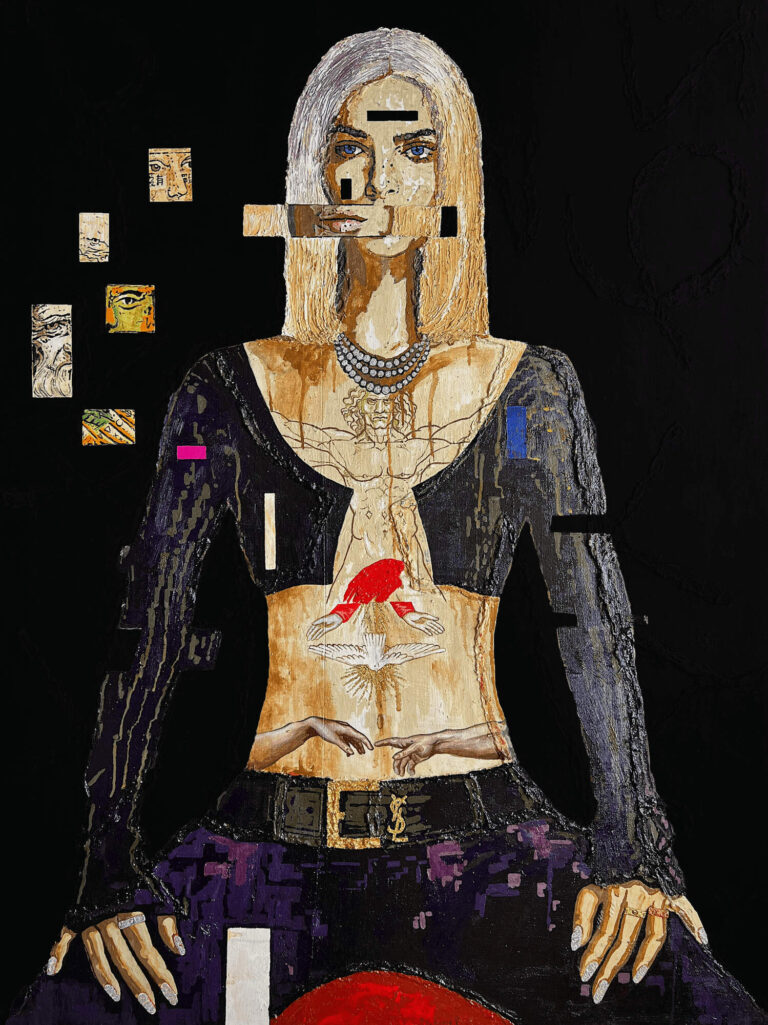
Every artist here treats the face as public property, and that is what makes the subject work. Each one adds a different tool: a pencil, a silkscreen, an oil stick, a smiley. Mine is a glitch, and that is why Mona Lisa pop art still has room for another painter. It also means a modern Mona Lisa is mostly a picture about how we receive images now. A different work of mine starts from Leonardo’s Vitruvian Man drawing, with the same sliding strip across a woman’s face: Leonardo Da Vinci Dreams.
More on how I make the lithographs is on the lithography page.
Anonymous contemporary pop artist with a studio in Poland. I paint original pop art in oil and acrylic and make hand-finished lithographs. About me · More from my journal