

Why would anyone paint a mistake by hand? It is a fair question. Most of what we call a glitch is a thing a machine did by accident, and it usually lasts a fraction of a second. So when I think about glitch art meaning, I start with the accident, because the meaning sits there and nowhere else. A glitch is the moment a screen stops pretending to be a window and shows what it is made of.
I think that is also why the subject keeps coming back. We spend most of the day looking at faces through glass. Once that glass fails, you notice it was there all along.
Strip away the aesthetics and a glitch is a small failure in a system that normally hides its own work. A file is read wrongly. A signal arrives in pieces. A page loads with half its parts missing. The result looks like damage, but it is really information about how the thing is built.
That is the part I find interesting. A clean image tells you nothing about the pipe it came through. A broken one tells you a lot. Stripes, blocks, smears and shifted bands are the medium talking about itself, usually when nobody asked it to.
The television with a magnet
In 1965 Nam June Paik put a large magnet on top of a television set and called the result Magnet TV. The magnet bends the broadcast picture into abstract shapes, and visitors could move it themselves and change the picture. The piece belongs to the Whitney Museum of American Art, and you can see it in their collection record.
What I take from it is simple. The picture is not sacred. You can push it, and it pushes back. The viewer becomes part of the failure, which is a very different thing from watching a clean broadcast.
A broken website and a melting film
Thirty years later the machine was the browser. JODI, the duo of Joan Heemskerk and Dirk Paesmans, launched jodi.org in 1995, and the site looked broken on purpose. Instead of a normal page you got raw code and browser chaos. If you want the background, the Net Art Anthology is a good place to start. I like that the joke has teeth: the site refuses to behave like a brochure, and that refusal is the whole work.
Then there is Takeshi Murata. His short video Monster Movie, from 2005, starts from a clip of the 1981 film Caveman. Murata removed data from the compressed video, and the image melts into moving pixels. It is an early and clear example of what people now call datamoshing. The Smithsonian American Art Museum holds it.
Three artists, three different machines, one habit: let the system fail and then look carefully at the failure.
Menkman and the problem of the preset
The Dutch artist and theorist Rosa Menkman wrote the Glitch Studies Manifesto, first circulated in 2010 and later printed in the Video Vortex Reader II. As I read it, her central point is that a glitch is a moment when the medium shows itself, and that it stops being a glitch once it turns into a style. Once there is a preset for it, the accident is gone. There is a short overview of her work and writing.
I agree with her, and it bothers me a little. Open any photo app and you can add a glitch with one tap. It is fast, it looks fine and it says nothing. The effect has become wallpaper.
Why I paint glitches by hand
My answer is slowness. When I paint a glitch portrait, the error is no longer an accident. Every stripe, every shifted band and every block of colour is a decision I made with a brush, and I can see how long each one took. Nothing here is a bug. That sounds like a contradiction, and I think it is the point: the machine’s mistake becomes a deliberate gesture, and the gesture is about the portrait.
The faces in my work are the faces we meet now: through screens, cameras and AI images. They arrive already processed, already a little wrong. I paint that arrival. Call it a glitch art painting, digital error art, or a quiet kind of contemporary pop art. I care less about the label than about what is visible on the surface.
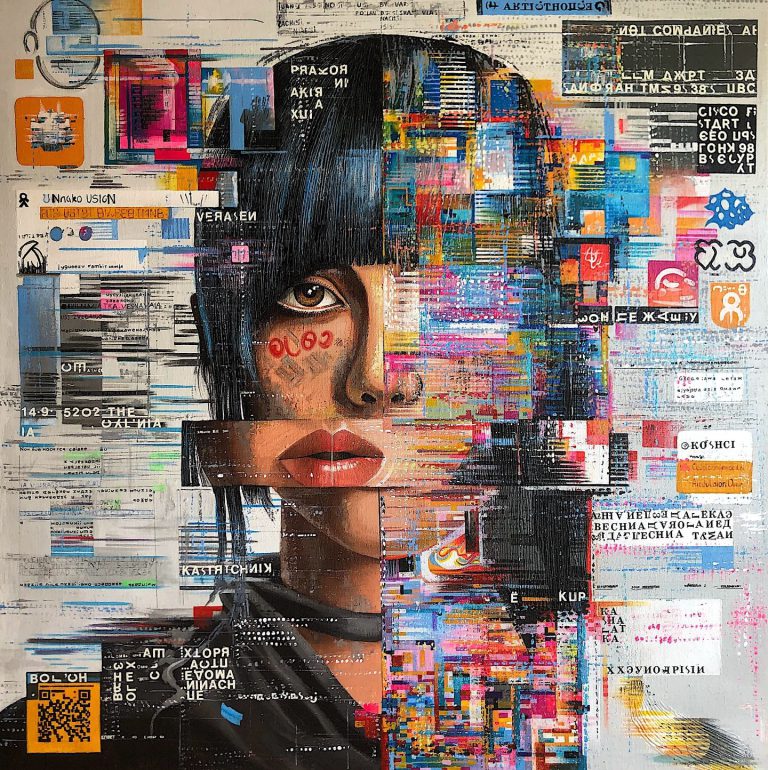
In Display Error, a young woman with a dark fringe looks out with one steady brown eye, while the right half of her face dissolves into coloured pixel blocks. A band across the mouth has slid sideways. Scrambled text labels and a QR code sit around the edges like leftovers from a crashed window. The original is still available and ready to ship, and it also exists as a hand-finished lithograph.
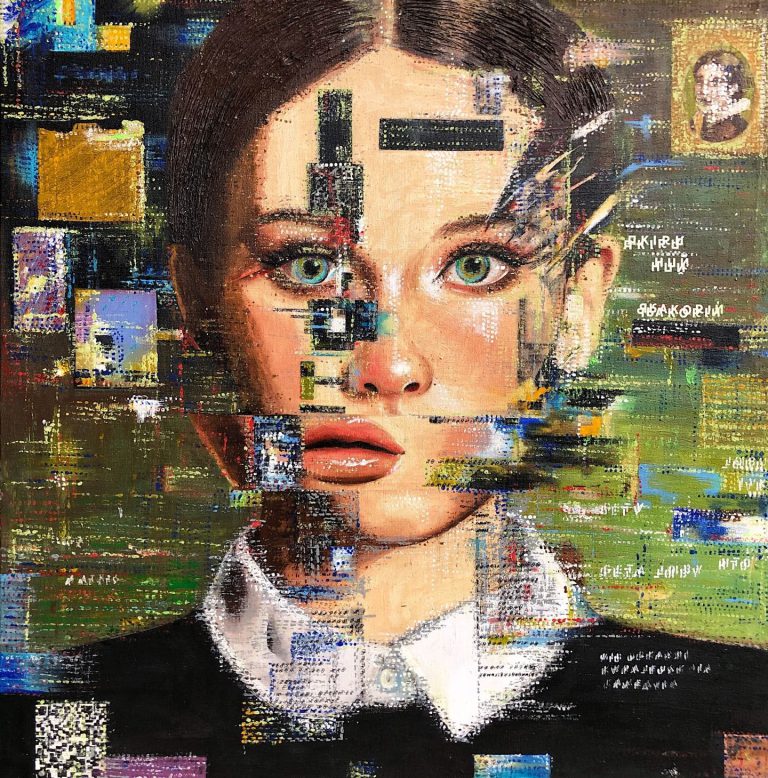
Human.exe goes the other way. The face is calmer, with wide green eyes and a white collar, but a dotted texture like a screen grid covers it, and black bars cut across the forehead. A folder icon floats in the green field behind. There is a lithograph of Human.exe as well.
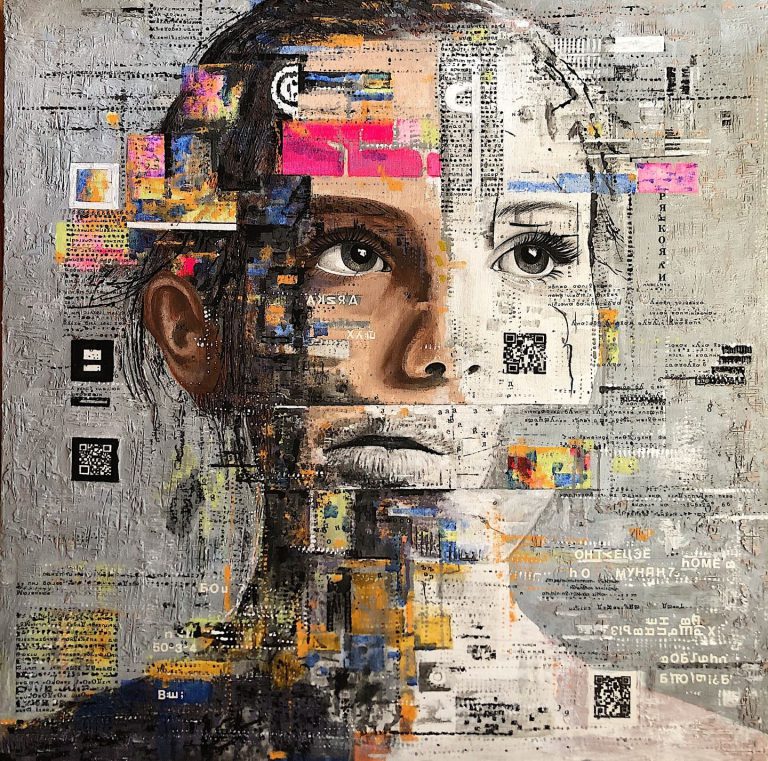
Anthropic splits one face down the middle. The left side is painted in warm colour, with an ear and loose dark hair. The right side is grey, almost a line drawing. Pink bars and QR codes cross the heavy, scraped grey ground. It is also available as a lithograph.
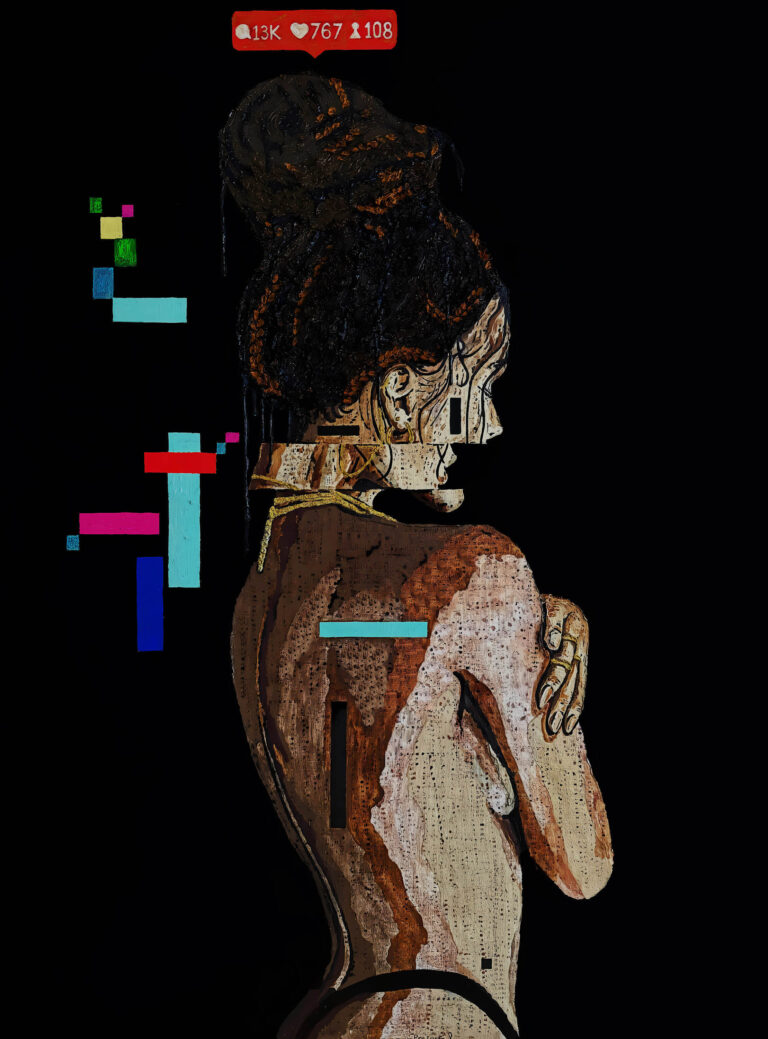
Glitch in the Matrix is the quietest of the four. A woman is seen from behind and in profile against a black field, her hair in a braided bun. Her neck is cut by a shifted strip, and a few bright rectangles hang to the left. Above her head sits a small red badge, the kind that counts attention. I wanted the error to be small there, because the black does most of the talking.
What to look for in a glitch portrait on a wall
A few practical things, none of them complicated. First, stand far away. From across the room the face should read at once, and the broken parts should look like part of the picture rather than damage to it. Then walk closer. This is where a painted glitch separates from a screen image: you can see the strokes, the dotted marks and the edges where one band meets the next.
Second, look at how the light moves. Painted stripes catch light differently from the flat areas around them, so the work changes as you walk past it or as the day goes on. A screen cannot do that.
Third, think about the room. These pictures work in a living room, an office, a hallway, anywhere you want one strong face to hold the wall. They do not need a lot of space around them, but they do like a plain wall.
If you would rather live with the same imagery at a quieter scale, I also make hand-finished lithographs, with acrylic strokes and a textured gel that goes on white and dries completely clear. Same idea, a different way into it.
Start with the lithographs, or go straight to the originals.
Anonymous contemporary pop artist with a studio in Poland. I paint original pop art in oil and acrylic and make hand-finished lithographs. About me · More from my journal