

Money is the most reproduced image in the world. Every bill is a tiny printed artwork, designed to be copied millions of times and trusted by people who never look at it closely. Maybe that is why artists keep stealing it.
I am one of them. I paint money, and I have my reasons. Before I get to those, here are three stories I keep coming back to. They explain money in art better than I can.
In 1962 Andy Warhol started making paintings of dollar bills, first by hand and then with silkscreen. Rows of them, flat and repetitive, like a sheet fresh off the press. Nobody had to explain the joke. A painting of money is worth a lot of money, so what exactly are you buying?
That question is the whole of dollar bill art in one line. The bill is already an image. Warhol did not have to invent a subject. He pointed at one that sat in every pocket and repeated it until it stopped being a bill and became a pattern. Pop art money still looks like that: flat, bright, a little too cheerful.
He came back to the subject in 1981 with the Dollar Sign series. Just the symbol, big and loose, in candy colours. By then Warhol was openly saying that making money was art and good business was the best art. People still argue about whether he meant it. I think he did, and I think he also found it a little funny. The Andy Warhol dollar sign is a joke and a business plan at once, and it never has to choose.
The man who paid with drawings
J.S.G. Boggs took the idea somewhere stranger. He drew banknotes by hand, one side only, and then tried to spend them at their face value. A waiter or a shopkeeper had to decide whether a drawing of ten pounds was worth ten pounds. Many said yes. The Bank of England was less amused, and in 1987 he stood trial in London over his drawings. The jury acquitted him.
What I like about Boggs is that the artwork was the transaction. The drawing was only half of it. The other half was the moment someone had to decide what value actually is.
He needed very little for this. Paper, a pen and a stranger across a counter. Nobody asked a critic if the drawing was good. They asked if it was worth ten pounds. That is a harder test than any gallery sets.
A board game that was meant as a warning
Monopoly has a story most players never hear. Its ancestor, The Landlord’s Game, was patented by Lizzie Magie in 1904. She designed it to show how landlords get rich while everyone else pays rent. Parker Brothers published Monopoly in 1935, and over the years the game about the evils of monopolies turned into a game about the joy of owning everything.
That reversal is why the little man in the top hat shows up so often in street art and pop art. Alec Monopoly built a whole career around him. He is the friendliest possible face of greed. You can put him on a wall and nobody feels attacked.
Monopoly art works because the rules of the joke are already in everyone’s head. Magie wanted players to notice who loses. The version that sold taught them to enjoy winning. I find it hard to look at that little man without thinking of both.
How I paint money
My method is different from all three, but I borrow the same trick. Pick something everyone recognises, then let it go wrong a little.
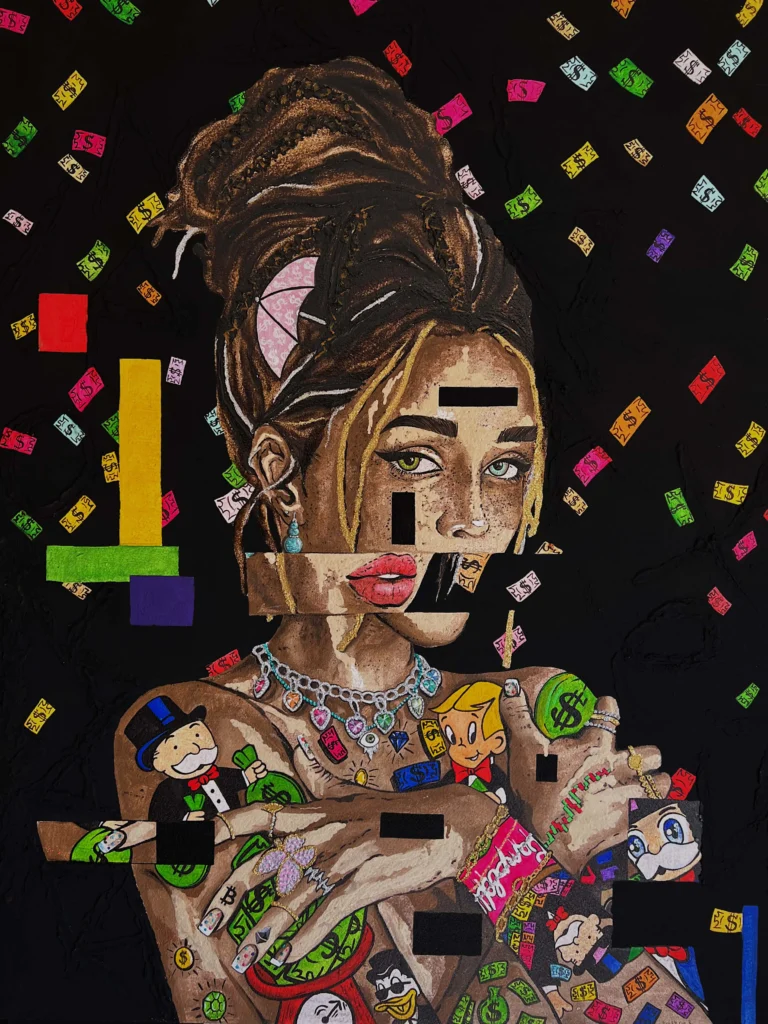
I painted Monopoly Dreams with that character on purpose. The original is 120×90 cm and belongs to my series The Artists Are Silent. It is sold, but commissions are possible in any size, and the work has its own page in the catalog. In it, a woman is covered in cartoon money tattoos: the Monopoly man with his cash bags, a rich cartoon kid, a duck in a top hat. Dollar bills fall around her like confetti. Her jewelry is perfect. Her face is the only thing that breaks, sliced into strips with black bars across it.
That is my answer to the question Warhol and Boggs kept asking. The things we buy stay sharp. The person underneath starts to glitch.
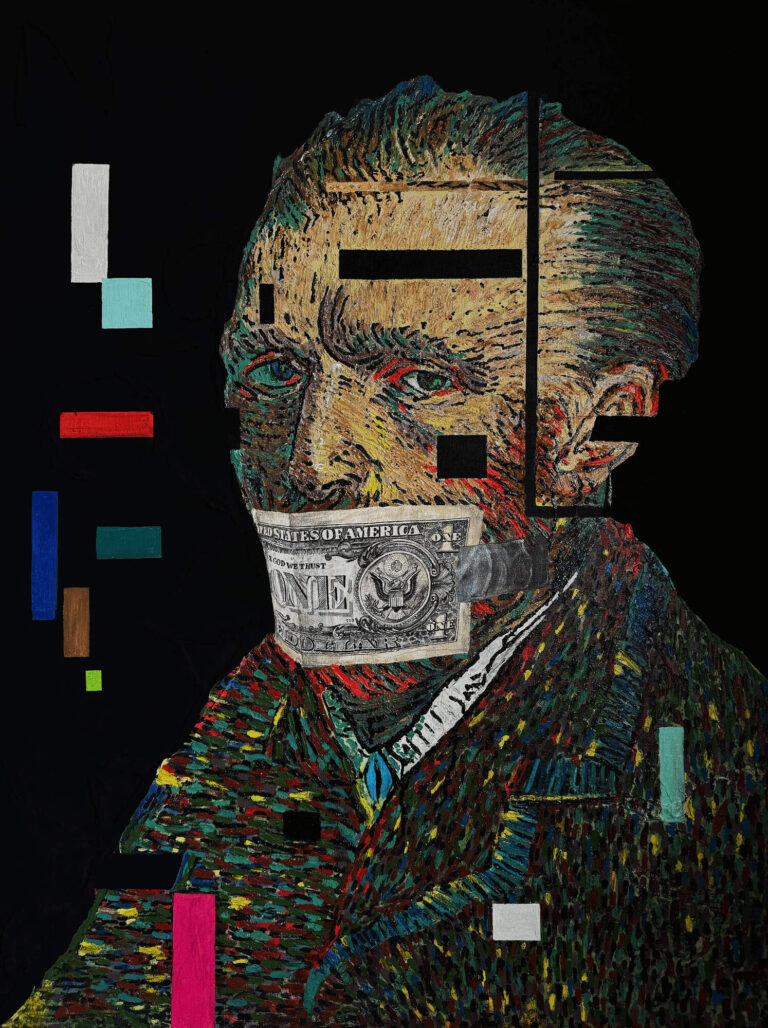
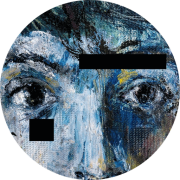
Power and the Money is quieter and harsher. A man painted in short, thick strokes has a one-dollar bill over his mouth, held in place with grey tape. Black bars cut across his face. Small blocks of colour float in the dark behind him. He cannot speak. The bill speaks for him.
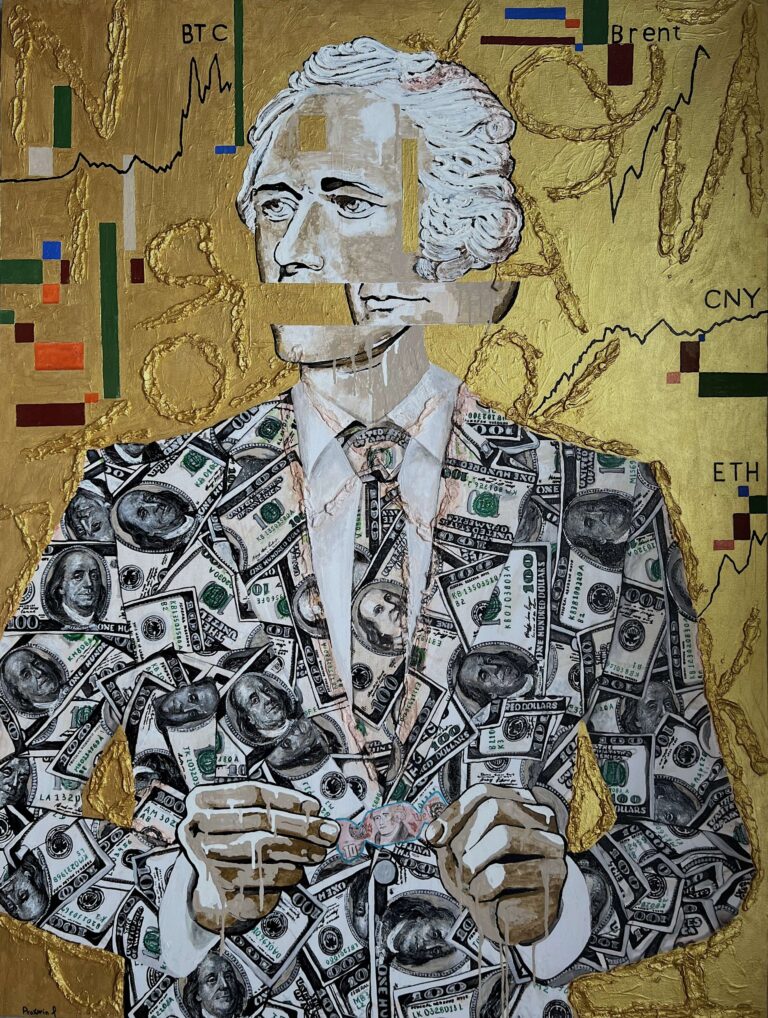
Benjamin Dreams moves to gold. A figure with white curled hair stands in a suit made of hundred-dollar bills. Benjamin is slang for a hundred, and this suit is nothing else. The face is cut into strips. A small banknote hangs between his fingers. Thin black lines run behind him like price charts, labelled BTC, Brent, CNY and ETH.
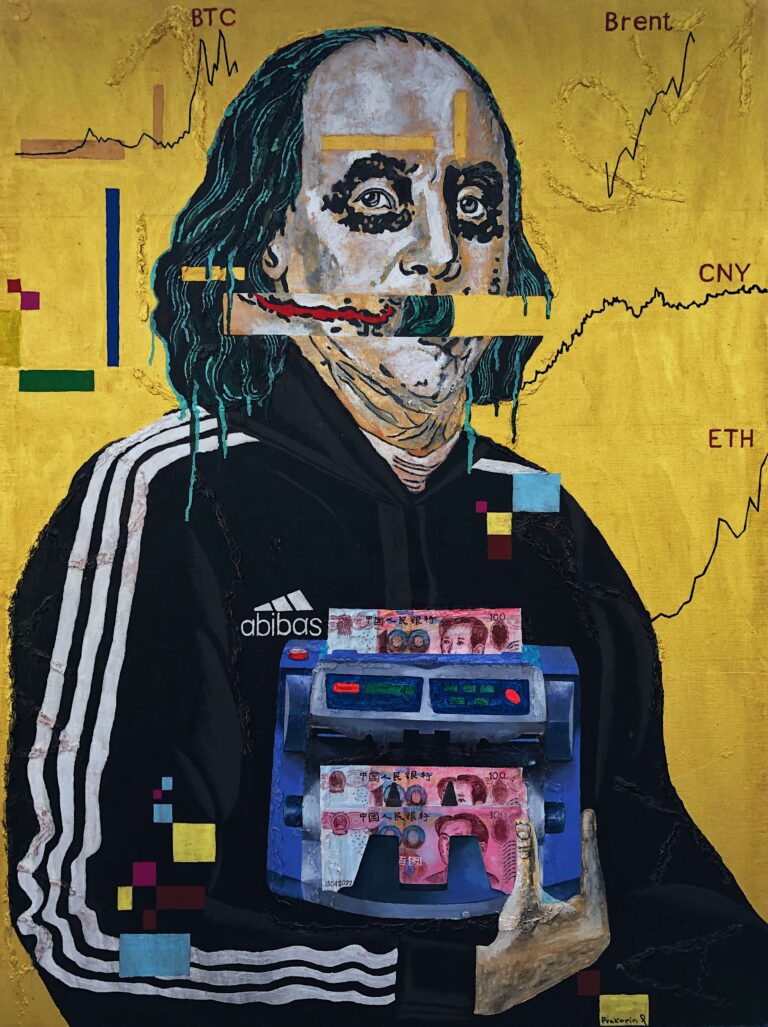
SCAM keeps the gold and the charts. A man in a black hoodie with white stripes holds a banknote counting machine loaded with Chinese banknotes. The lettering on his chest says “abibas”. I did not try to hide that joke. His face is sliced too.
Two more use the same setup. In NOTHING, a man in a white sweater covered in doodles of a luxury label, spelled “Dalse & Gobano”, holds out a plate of one-dollar bills. In The pure gold, a man in a black and gold baroque sweater carries a toilet covered in gold, in both hands.
In all of them the stuff is painted with care and the face is cut up. That is the point.
Why money still works as a subject
Money changes shape every few years now. Paper, then cards, then phone payments, then crypto. Artists keep painting it because it is a shared language. Everyone recognises a dollar sign in half a second, from Warsaw to Toronto, and that speed lets an artist say something uncomfortable before the viewer has time to look away.
There is also a simpler reason. A painting about money hangs in a room where someone paid money for it. The joke never stops working.
A money painting cannot pretend to be above its own price tag. Money wall art is an odd category for that reason. Some of it is made to look rich. I would rather make pictures that look back at the money.
If you want one on your wall
If you want to see how this looks on a real wall, start with my lithographs. Each is a print of an original, finished by hand with my acrylic brushstrokes (40–50%) and textured gel that dries clear. Framed, with a serial number and a certificate. Most are 60×80 cm and cost €400. For a larger size or a subject of your own, see the originals, where commissions are open in any size. Or write to me on Instagram.
Anonymous contemporary pop artist with a studio in Poland. I paint original pop art in oil and acrylic and make hand-finished lithographs. About me · More from my journal